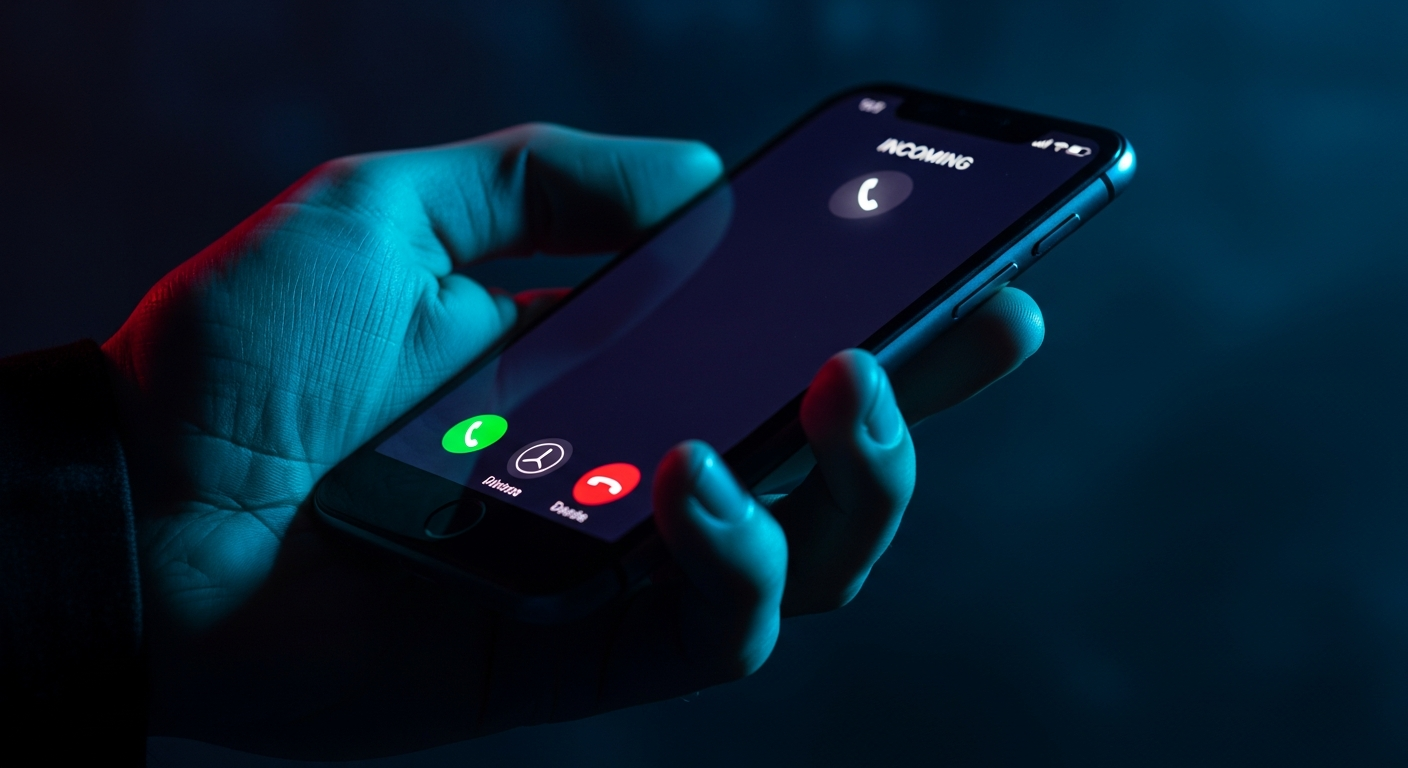
Chicago Man Lost $69K to AI-Generated Badge Scam
What happened
Why it matters
How to protect yourself
Sources
What happened
A suburban Chicago man received a phone call from someone claiming to be Apple Support. Within the hour, he had been transferred to a man identifying himself as Silas V. Darden, a U.S. Marshal.
When the man hesitated, “Darden” texted him a photo: an official-looking law enforcement badge bearing that name. Convinced he was speaking with a real federal officer, the man drove to a Bank of America branch in Woodridge, Illinois, and wire-transferred $24,000 to an account he was told would be in his own name “for protection.” Several days and multiple follow-up calls later, he wired another $45,000.
The badge photo was AI-generated. The real Silas V. Darden, a former deputy director of the U.S. Marshals Service, had left the agency two years earlier. The phone number was spoofed. The case was a textbook government-impersonation scam, updated for the AI era.
This case file examines how the scam worked, why the AI-generated badge was the key that unlocked the victim's trust, and what families can do to protect themselves from fake federal agents.
Part One: What Happened: The $69,000 Scam
In a May 5, 2026, CBS 2 Chicago Investigators report by Carol Thompson (Investigative Producer) and Dorothy Tucker (Reporter), the family of the anonymous Chicago-area victim laid out a scam that began in March 2026 and drained more than 40% of the man's lifetime liquid savings.
The Apple Support Pivot
It started with a phone call. The caller claimed to be from Apple Support. The victim, who uses Apple products, was told that his account had been compromised by “fraudulent charges” that needed to be addressed immediately.
This is a classic scam opening, the “tech support pivot.” The scammer creates a sense of urgency around a familiar technology product, then transfers the victim to a second scammer who impersonates a law enforcement officer. The pivot serves two purposes: it establishes a plausible reason for the call, and it transfers the victim from a “customer service” context to an “official government” context, which carries more authority.
The U.S. Marshal Transfer
The Apple Support scammer told the victim that his case was being transferred to a U.S. Marshal for resolution. Within minutes, a second caller came on the line, identifying himself as Silas V. Darden, a U.S. Marshal.
The name was not random. Silas V. Darden is a real person, a former deputy director of the U.S. Marshals Service who served in senior leadership roles for decades. His name and former title were publicly available information. The scammer had likely found Darden's name through a simple internet search.
“When they use that term, it scares people,” the victim's son, identified only as Tony, told CBS. “It puts fear in them.”
The AI-Generated Badge Photo
The victim hesitated. He asked for proof that he was speaking with a real law enforcement officer. The scammer was ready.
Within moments, the victim received a text message containing a photograph. The photo showed an official-looking law enforcement badge. The badge displayed the name “Silas V. Darden” and appeared to carry the official markings of the U.S. Marshals Service.
To the victim, who had no reason to suspect that a photograph could be fabricated, the badge was proof. He was speaking to a real U.S. Marshal. The badge said so.
The U.S. Marshals Service later confirmed to CBS that the badge photo was completely fabricated by artificial intelligence. “Oh, that was completely generated by AI,” said Brady McCarron, deputy chief of the USMS Office of Public Affairs. The real Silas V. Darden had left the agency two years earlier. He was not involved in any investigation. He had never called the victim.
The Wire Transfers
Following the scammer's instructions, the victim drove to a Bank of America branch in Woodridge, Illinois (not his usual branch). He wired $24,000 to a Wells Fargo account he was told would be in his own name “for protection.”
The account was not in his name. It was a scammer-controlled account.
Several days later, after multiple follow-up calls from the scammer to maintain pressure, the victim wired another $45,000. In total, more than $69,000, more than 40% of his lifetime liquid savings, was gone.
“For him, it's more than 40% of his total lifetime cash liquid savings,” Tony told CBS. “Devastated. He's in a very dark place.”
The Aftermath
The victim's family discovered the loss and immediately began working to freeze accounts and recover funds. They contacted Bank of America, Wells Fargo, and the Illinois Attorney General's office. The receiving accounts have since been closed, but the money was not recovered.
The victim, CBS reported, was “too embarrassed to reveal his face or use his name.” He agreed to share his story only through his son, in the hope that others would not make the same mistake.
“He's a very cautious person,” Tony said of his father. “But these scammers are pros.”
Part Two: The AI Variable: Why the Badge Worked
The Chicago case illustrates exactly how AI has changed the government-impersonation scam. The badge photo was the key that unlocked the victim's trust.
The Old Playbook: The Phone Call Alone
Before AI, government-impersonation scams relied entirely on the phone call. The scammer claimed to be a federal agent. They used official-sounding language. They created urgency. But they had no physical proof.
Many potential victims hung up. Without visual evidence, the scammer's claims remained unverified.
The New Playbook: The AI-Generated Badge
Now, scammers can text a photo on demand. The photo looks official. It has a government seal. It has a name. It has a badge number. It looks, to a non-expert, exactly like a real law enforcement credential.
The victim sees the photo and stops doubting. His brain accepts the visual evidence as proof. The scammer has bridged the credibility gap.
“They believe the phone number's real,” McCarron told CBS. “They believe the photo is real. They're now using pictures. Those pictures are created by AI. Don't fall for them.”
How the Badge Was Generated
AI image generators (tools like Midjourney, DALL-E, and Stable Diffusion) can produce convincing law enforcement badges with minimal effort. The scammer needs:
- A prompt specifying the agency (U.S. Marshals Service)
- A name to appear on the badge (Silas V. Darden)
- A badge number (real badge numbers are often publicly available)
- A description of the badge's appearance (gold, shield-shaped, agency seal)
The AI generator produces an image in seconds. The scammer texts it to the victim. The victim believes he has seen proof.
The Real Silas V. Darden
The scammer's use of a real former official's name is not accidental. Silas V. Darden is a real person with a real public profile. A quick internet search would reveal his name, his former title (deputy director of the USMS), and his long career in federal law enforcement.
If the victim had searched for “Silas V. Darden” online, he would have found legitimate news articles, official USMS press releases, and professional biographies. That search would have confirmed that Darden is a real person who once held a senior position at the Marshals Service.
What the search would not have revealed is that Darden left the agency two years ago and has nothing to do with the call. The scammer exploited the gap between public information (Darden is a real former official) and current reality (Darden is not calling anyone about Apple account fraud).
Why it matters
Part Three: The Federal Data: Government-Impersonation Scams Are Surging
The Chicago case is not an isolated incident. It is part of a national surge in government-impersonation scams. As AuthentiLens reported in our coverage of the FBI's 2025 IC3 Annual Report , AI-enabled fraud is accelerating across every category, and government impersonation is leading the surge.
The FBI IC3 Numbers
According to the FBI's 2025 Internet Crime Complaint Center (IC3) Annual Report, government-impersonation complaints nearly doubled in a single year.
- 34,000+ complaints logged in 2025
- $798 million in total losses (a 97% jump from 2024)
- $413 million of that total came from victims aged 60 and older
Government-impersonation scams now rank among the highest-loss fraud categories tracked by the IC3. They are more damaging than tech support scams, more prevalent than romance scams, and growing faster than almost any other category.
The 97% Year-over-Year Increase
The 97% increase from 2024 to 2025 is extraordinary. Few fraud categories double in a single year. The IC3 attributes the surge to two factors:
- AI-powered impersonation tools that make scams more convincing
- Widespread data breaches that give scammers access to personal information they can use to personalize their approach
The Chicago case illustrates both factors: the AI-generated badge provided visual proof, and the scammer likely had enough personal information about the victim to make the Apple Support pivot seem plausible.
The 60+ Demographic
Victims aged 60 and older accounted for $413 million of the $798 million in government-impersonation losses, more than half. Older adults are disproportionately targeted because:
- They are more likely to have landlines and less likely to use caller ID verification
- They are more likely to trust official-sounding callers
- They may be less familiar with AI image generation and voice cloning
- They often have more savings to lose
The Chicago victim's age was not disclosed in the CBS report, but the pattern is consistent. Government-impersonation scammers target older adults because the return on investment is higher.
The Apple Support Pivot Pattern
The FBI IC3 report specifically notes that many government-impersonation scams begin with a “tech support pivot”, a call claiming to be from Apple, Microsoft, Amazon, or a bank, which is then transferred to someone claiming to be a federal agent.
This two-step approach is effective because:
- The victim has already engaged with the first caller
- The transfer creates a sense of escalation and seriousness
- The federal agent claims to be “investigating” the fraud, creating a partnership dynamic
The Chicago victim followed this exact pattern. He engaged with the Apple Support caller, was transferred to a “U.S. Marshal,” and then followed instructions because he believed he was cooperating with an official investigation.
The same government-impersonation playbook is also being used in AI-staged fake immigration court hearings , where scammers wearing judicial robes drain victims' life savings in fake legal proceedings, a different agency target, the same AI-generated visual evidence at the core.
Part Four: The U.S. Marshals Service Warning: McCarron's Statement
Brady McCarron, deputy chief of the USMS Office of Public Affairs, was unequivocal in his statement to CBS. His words are worth quoting at length:
“Oh, that was completely generated by AI. That's not a real badge. That name, Silas Darden, is a real person. He's a former deputy director of the U.S. Marshals Service. He left the agency two years ago.”
McCarron continued with the most important warning for consumers:
“Law enforcement will never call you. We will never ask for any money. We don't ask for money. If there's a financial, that's not how we operate. So if anyone calls you claiming to be law enforcement, asking for gift cards, money, any kind of financials, that is a fraud. That's a scam. Hang up.”
The “Never” Rule
The U.S. Marshals Service, like the FBI, the IRS, the Social Security Administration, and virtually every other federal agency, has a simple, inviolable rule: they never call out of the blue to demand money or personal information.
- They do not call about Apple account fraud
- They do not call about compromised bank accounts
- They do not call about unpaid taxes
- They do not call about missing jury duty
- They do not call about outstanding warrants
If you receive a call from someone claiming to be a federal agent who then asks for money, personal information, or action on a financial account, it is a scam. There is no exception.
The Photo Warning
McCarron also directly addressed the AI-generated photo:
“They believe the photo is real. They're now using pictures. Those pictures are created by AI. Don't fall for them.”
This is a critical public education point that has not yet reached most consumers. Many people still believe that a photograph is proof. They trust what they see. Scammers know this, and they exploit it.
The solution is simple: treat any photo of a badge, ID, or credential sent by a stranger as unverified. Do not trust it. Verify through an independent channel: call the agency's official number, look up the officer's name online, or ask to meet in person at a police station.
The FBI has also warned that this tactic extends far beyond badges. As AuthentiLens reported in our coverage of the FBI's deepfake scam warning , and AI impersonation (including voice cloning and AI-generated images) has ‘skyrocketed’ and is now the leading vector for consumer fraud losses.
Part Five: The Illinois Legislative Context: HB 4767
The CBS Chicago report also noted that Illinois lawmakers are considering new legislation to protect older adults from exactly this type of scam.
Illinois House Bill 4767 would expand the state's Adult Protective Services Act to require all financial institutions (not just banks) to report suspected financial exploitation of vulnerable adults. The bill would also give financial institutions clearer authority to delay suspicious transactions to allow time for verification.
While the bill is broader than just scam prevention, its provisions would apply directly to cases like the Chicago victim's wire transfers. If the bill passes, banks would have more tools to flag unusual wire transfers, especially those involving accounts the victim does not normally use, branches the victim does not normally visit, and amounts that represent a large percentage of the victim's savings.
The CBS report noted that the bill was pending in the House Rules Committee at the time of publication.
Consumer data underscores the urgency. As AuthentiLens reported in our coverage of the Bankrate survey on AI scams , 73% of Americans have already been targeted by financial fraud, and AI is making those scams harder than ever to spot, precisely because tools like AI-generated badges eliminate the tells that once allowed victims to recognize a scam in progress.
How to protect yourself
Part Six: How to Spot a Fake U.S. Marshals or Government Badge Scam and Protect Yourself
The AuthentiLens editorial team has distilled the Chicago case, the McCarron statement, and the broader federal data into six concrete protections.
1. Hang Up on Any Caller Claiming to Be From Law Enforcement, the IRS, Social Security, or Any Government Agency That Asks You to Do Anything Financial
McCarron's statement could not be clearer: “Law enforcement will never call you. We will never ask for any money.”
There is no exception to this rule. The FBI does not call about Apple account fraud. The U.S. Marshals do not call about pending warrants. The IRS does not call about unpaid taxes. The Social Security Administration does not call about suspended benefits.
If someone calls claiming to be from a government agency and then asks you to take financial action (wire money, buy gift cards, send cryptocurrency, or read a verification code), hang up. It is a scam.
For more details, see our guide on signs of an impersonation scam .
2. Treat Any Photo of a “Badge” or Official ID Sent by a Stranger as an Unverified Image, Not Proof of Identity
AI image generators can now produce convincing badges with any name and any agency on demand. The Chicago case used a real former official's name on a fabricated photo. The badge looked real. It was not.
- Do not trust a badge photo sent via text
- Do not trust a badge photo sent via email
- Do not trust a badge photo shown on a video call
If you need to verify that someone is a law enforcement officer, ask them to meet you in person at a police station. Real officers will agree. Scammers will not.
For a detailed guide to spotting AI-generated images, see how to tell if a photo is fake or AI-generated .
3. Never Wire Money to an Account “in Your Own Name” at a Bank You Do Not Normally Use
The Chicago scammer told the victim that the Wells Fargo account would be in his own name “for protection.” This is a lie. Real protection of your funds never requires you to drive to a different branch and wire to an unfamiliar account.
- A real bank fraud department will not ask you to move money to a different bank
- A real law enforcement officer will not ask you to wire money to an account in your name
- A real government agency will not ask you to open new accounts to “protect” your funds
If someone asks you to do any of these things, it is a scam.
4. Add a Trusted Family Member as a Trusted Contact on Older Relatives' Accounts
CBS Chicago specifically flagged this protection. The Trusted Contact is a person, usually a family member or close friend, who the bank can contact if they notice unusual activity on the account.
- The Trusted Contact does not have access to the account
- The Trusted Contact cannot move money or make transactions
- The Trusted Contact is simply someone the bank can call to verify that a transaction is legitimate
This protection is especially important when protecting elderly parents from scams . If the Chicago victim had a Trusted Contact listed on his account, the bank might have called that person before processing the $24,000 wire transfer. The call might have stopped the scam.
5. Verify Any Inbound “Apple,” “Microsoft,” “Bank Fraud Team,” or “Government” Call by Hanging Up and Calling Back on a Number You Already Know
The rule is simple: hang up and call back.
If someone calls claiming to be from Apple Support, hang up. Call Apple's official support number, which you can find on Apple's website or in the Settings app on your device. Ask if there is an issue with your account. There will not be.
If someone calls claiming to be from your bank, hang up. Call the number on the back of your card. Ask if there is a problem. There will not be.
If someone calls claiming to be a U.S. Marshal, hang up. Call the U.S. Marshals Service public number, which you can find on USMS.gov. Ask if an officer named Silas V. Darden is calling people about Apple account fraud. They will tell you no.
For a complete guide, see how to tell if a phone call is a scam .
6. Scan It With AuthentiLens
You are not expected to become an AI-detection expert or a federal-agency protocol expert. That is what AuthentiLens is for.
When you receive a suspicious call, text, voicemail, photo, or “badge image” from someone claiming to be a government official:
- Upload the image to AuthentiLens. We will analyze it for AI-generation signals, including inconsistent lighting, garbled text, unnatural symmetry, and missing metadata.
- Paste the phone number into AuthentiLens. We will check it against known scammer databases and cross-jurisdictional patterns.
- Paste the text message into AuthentiLens. We will flag scam language patterns, urgency cues, and impersonation signals.
- Upload the audio if you have a voicemail or call recording. We will analyze for voice-clone artifacts and synthetic speech markers.
We do all of this in seconds, before you wire money, before you buy gift cards, before you send a single dollar to a scammer who does not deserve it.
Part Seven: What to Do If You Have Already Been Scammed
If you or someone you love has sent money to a government-impersonation scammer, take these steps immediately:
- Step 1: Stop. Do not send any more money. Do not answer calls from the scammer. The scammer will escalate pressure. Ignore it.
- Step 2: Contact your bank or payment provider. Call the number on the back of your card immediately. Explain that you have been the victim of a scam. They may be able to reverse wire transfers or freeze accounts. The sooner you call, the better.
- Step 3: File a police report. Go to your local police department. Bring all evidence: phone numbers, text messages, photos, wire transfer receipts. The report creates a paper trail.
- Step 4: File a complaint with the FBI's IC3. Go to IC3.gov . The FBI uses these complaints to track cross-jurisdictional scam rings. As AuthentiLens reported in our coverage of the FBI's 2025 IC3 report , every complaint helps.
- Step 5: File a complaint with the Federal Trade Commission. Go to ReportFraud.ftc.gov . The FTC uses these complaints to build cases and warn other consumers.
- Step 6: Tell your family. Shame is the scammer's greatest ally. The silence is what they count on. You did nothing wrong. You were targeted by professionals using the most advanced tools available. Telling your family may protect them from the same scam.
The Chicago victim's son, Tony, spoke to CBS because he wanted to warn others. “He's a very cautious person,” Tony said. “But these scammers are pros.”
The goal of this case file, and of AuthentiLens, is to make sure that the next person who gets that call does not have to learn the hard way.
Related Coverage From AuthentiLens
- AI Scammers Hold Fake Immigration Court Hearings, Drain Savings The same government-impersonation playbook targeting immigrants with fake judges and fake courtrooms.
- FBI: AI Deepfake Scams Have ‘Skyrocketed,’ Voice Cloning Leads The FBI's warning about AI impersonation as the leading threat vector.
- AI Is Making Scams Harder to Spot: 73% of Americans Targeted The consumer-survey data showing how AI has eroded traditional scam defenses.
- FBI: AI Scams Drained $893M From Americans in 2025 The federal statistical baseline for AI-enabled fraud, including the government-impersonation surge.