AI Wedding Ring Scam Targets Lost-Item Posters
What happened
Why it matters
How to protect yourself
Sources
What happened
A woman in Pelham, Alabama, lost her wedding ring. Like millions of people before her, she did what came naturally in 2026: she posted a photograph of the ring on social media, along with a plea for help finding it.
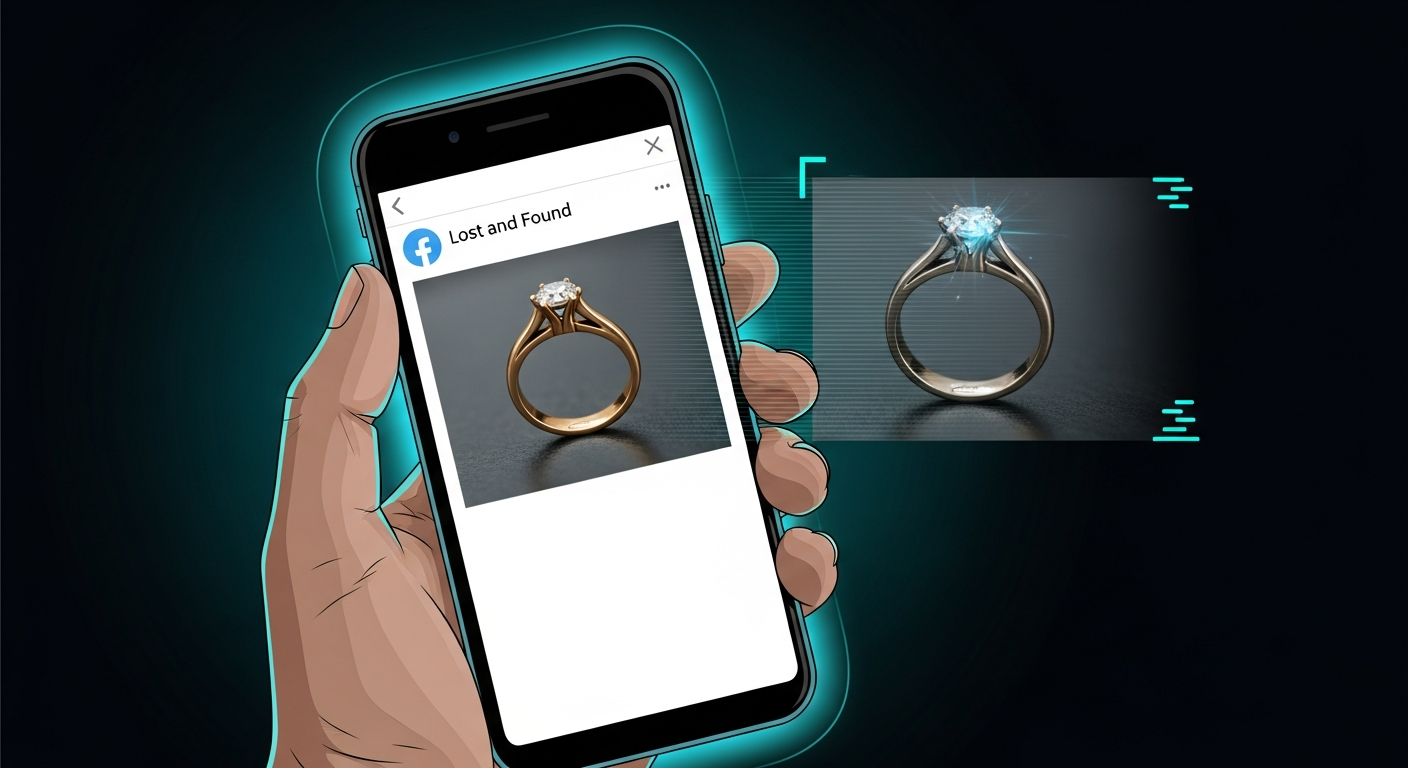
Within hours, a stranger contacted her. He claimed to have found the ring at a pawn shop. He sent her a photograph as proof, a clear image of what appeared to be her ring, sitting on a counter. He would return it, he said. He just needed a fee first.
The photograph was AI-generated . The ring in the image had never existed outside a computer model. And the phone number that contacted her had already been used across state lines, against victims in other jurisdictions who had paid and never received their jewelry.
The Pelham Police Department is now warning the public. And the same playbook, they say, is being run against people searching for lost pets.
What Happened: The Pelham Case
According to an April 29, 2026 report in People magazine by Joyann Jeffrey, based on local reporting by WBRC in Birmingham, Alabama, the Pelham Police Department walked through the mechanics of a new and deeply cruel AI scam.
A woman in Pelham posted a photo of her lost wedding ring on social media. Scammers monitoring lost-item posts spotted the image. Using that photograph as a reference, they generated a new AI image that appeared to show the same ring in a different setting, on a pawn shop counter, in a stranger's hand, on a piece of paper with a handwritten note.
The scammer contacted the woman, claimed to have found the ring, and sent the AI-generated image as “proof.” He demanded a fee to return it. The woman became suspicious and contacted the police instead of paying.
“Luckily, at that time she did not send him any money, and we were able to stop it,” said Sgt. Iliana Hayakahua of the Pelham Police Department. “We did some investigation and determined that number that contacted her was utilized across state lines, at other jurisdictions, where they actually had victims.”
Those other victims, Hayakahua said, paid money and never recovered their jewelry. The phone number had been used in multiple states, against multiple victims, with the same script and the same AI-generated “proof” images. The scammers were running the playbook in parallel across jurisdictions, recycling the same phone number until it was eventually flagged.
The technical playbook: how the scam works
The Pelham Police investigation revealed a multi-step process that combines social media monitoring, AI image generation, and cross-jurisdictional phone spoofing.
Step 1: monitoring lost-item posts
Scammers monitor public social media posts, Facebook, Nextdoor, Reddit, and neighborhood groups, for people announcing lost items. The most valuable targets are sentimental items with high emotional value but moderate monetary value: wedding rings, engagement rings, heirloom jewelry, class rings, and sentimental pets.
The scammer does not need to know the victim personally. They only need to find a post that includes a photograph of the lost item. The photograph provides the visual reference that the AI generator needs.
Step 2: AI image generation
Using the victim's photograph as a reference, the scammer inputs the image into an AI image generator with a prompt designed to produce a new image of the same item in a different context: a gold wedding ring with a diamond setting, photographed on a pawn shop counter; a silver band with inscription, held in a person's hand next to a handwritten note; a lost ring found on a sidewalk, photographed from above with a timestamp.
The AI generator produces a new image that appears to show the victim's actual ring in a new setting. The image is not perfect. AI generators still struggle with text on rings, precise inscription details, and consistent lighting. But it is good enough to cause an instant hope response.
Step 3: contact and proof
The scammer contacts the victim using a spoofed phone number, often one that has been used in multiple jurisdictions. They claim to have found the ring. They send the AI-generated image as “proof.” They explain that they are happy to return it, they just need a fee to cover “shipping,” a “finder's fee,” or “reimbursement for the pawn shop purchase.”
Step 4: payment and disappearance
If the victim pays, the scammer may ask for additional fees (“insurance,” “handling,” “taxes”) or simply disappear. The victim never receives the ring because the ring was never found. The image was fabricated from start to finish.
In the Pelham case, the victim did not pay. But Hayakahua confirmed that the same phone number had been used against other victims across state lines, and those victims did pay, receiving nothing in return.
The lost-pet variant: same playbook, different grief
The Pelham Police warning explicitly notes that the same playbook is being run against people searching for lost pets. This is not a hypothetical connection. AuthentiLens covered a Deltona, Florida case earlier this month in which scammers texted a family AI-generated photographs claiming the family's missing dog was injured and demanded thousands of dollars via Zelle for veterinary care.
The mechanics are identical:
- A pet owner posts a photograph of a missing dog or cat on social media.
- Scammers monitor lost-pet groups and pages.
- Using the pet's photo, they generate an AI image of the pet “injured” on a veterinary operating table.
- They contact the owner, claim to have found the pet, and demand payment for emergency care.
- The panicked owner, seeing what appears to be their pet, sends money.
- The pet is never returned because the scammer never had it.
Popular Science, Techlicious, and Stanford's Internet Observatory have separately documented the lost-pet variant since late 2025. The same AI image-generation tools that produce fake wedding rings produce fake injured dogs. The same emotional state, grief, hope, desperation, powers both scams.
As Sgt. Hayakahua told WBRC, these scammers do not care about people's feelings. They care about the moment when a person is most vulnerable and most likely to pay without thinking.
Why it matters
What makes this scam different from the romance scams, investment frauds, and business email compromises that AuthentiLens has covered is not the technology. It is the emotional state of the target.
Someone searching for a lost wedding ring is not in a position to think slowly. The ring may have sentimental value far beyond its material worth, a symbol of marriage, a family heirloom, a gift from a deceased spouse. The loss is fresh. The grief is active. The hope of recovery is desperate.
When a stranger contacts that person with a photograph that appears to show the lost item, the emotional response is immediate and overwhelming. The brain does not ask, “Is this image real?” It asks, “How do I get my ring back as fast as possible?”
The scammers know this. They design their outreach to land in that window of heightened emotion. The “proof” image is not designed to withstand forensic analysis. It is designed to cause an instant hope response that overrides verification instincts.
“They don't care about people's feelings,” Hayakahua told WBRC. “They don't care about people's emotions.”
That makes this a different category of AI fraud than the long-con romance scams or the authority-impersonation schemes we have covered. The fraud is not built on a long-term relationship or on impersonation of an institution. It is built on a single moment of hope. AI image-generation tools have made fabricating that moment trivially cheap, and the same phone number can run the playbook across dozens of jurisdictions in parallel.
Why this scam is so effective: the psychology of hope
The Pelham case reveals something important about the psychology of AI-powered fraud. Traditional scams rely on:
- Greed (you have won a prize, invest now for huge returns)
- Fear (your account has been compromised, pay now to avoid arrest)
- Curiosity (click this link to see something surprising)
The lost-item scam relies on hope.
Hope is a much more powerful emotion for fraud exploitation than greed or fear in one specific way: it is self-reinforcing. When a victim sees an image that appears to show their lost wedding ring, they actively want to believe it is real. They do not need to be persuaded. They persuade themselves.
This is the same psychological mechanism that makes the lost-pet scam so devastating. A pet owner who sees an AI-generated image of their dog “injured on an operating table” does not think, “This image might be fake.” They think, “Oh my God, my dog is hurt, I need to send money immediately.”
The scammer's job is not to convince the victim against their will. It is to provide a single piece of “evidence,” the AI-generated image, that the victim's own hope will magnify into proof.
The cross-jurisdictional pattern: one phone number, multiple states
One of the most concerning details in the Pelham Police investigation is the cross-jurisdictional pattern.
The phone number that contacted the Pelham woman had already been used “across state lines, at other jurisdictions, where they actually had victims,” Hayakahua said. Those victims paid money and never received their jewelry.
This is not a local scammer operating out of a basement. This is an organized operation using:
- Spoofed or disposable phone numbers that can be recycled across jurisdictions until they are flagged.
- AI image-generation tools that can produce unlimited “proof” images.
- Scripted outreach that can be deployed simultaneously against dozens of victims.
- Payment systems (Zelle, Venmo, CashApp, cryptocurrency) that are difficult to trace and reverse.
The same phone number can run the wedding-ring playbook in Alabama, the lost-pet playbook in Florida, the heirloom-jewelry playbook in Texas, all in the same week, all using the same AI-generated images, all demanding similar fees.
Pelham Police did not announce any arrests in their warning. The investigation is ongoing. But the cross-jurisdictional pattern suggests that this is not a small operation.
How to protect yourself
The AuthentiLens editorial team has distilled the Pelham Police warning and the broader AI lost-item scam pattern into six concrete protections.
1. Do not post a photo of a lost ring or pet on social media
This is the single most consequential change you can make. Pelham Police's explicit recommendation: post a written description only, not an image.
The photo is what gives the scammer the visual reference that an AI image generator needs to produce a convincing fake. Without the photo, the scammer cannot generate a believable “proof” image. They can try, but the image will not look like your specific ring or your specific pet, and that makes it much easier to spot as a fake.
If you must post a photo, consider these precautions:
- Add a visible watermark that would be difficult for an AI to remove or replicate.
- Use a low-resolution image that lacks the detail an AI generator needs.
- Post only in private groups where membership is vetted, not public pages.
But the safest approach is the simplest: written description only. Describe the ring's metal, stone, setting, and any unique inscriptions or markings. Do not include a photograph.
2. If someone contacts you claiming to have found the item, do not send money in advance
Sgt. Hayakahua's out-of-state victims who paid never received their jewelry. This pattern is consistent across lost-item scams: real finders almost never demand payment up front. They ask you to verify ownership first. They arrange a meeting in a public place. They do not insist on immediate payment via Zelle or cryptocurrency.
If someone demands money before you have seen the item in person, assume it is a scam.
3. Verify ownership through a detail only the real owner would know
Ask the contact for a photograph of a non-obvious feature:
- For a ring: an inscription inside the band, a specific scratch or mark, the precise arrangement of stones.
- For a pet: the collar tag, a unique marking not visible in the posted photo, the pet's response to a specific command or name.
Real finders can answer these requests. They can take a new photograph of the item in their possession, showing the requested detail. AI-generated fakes will:
- Hallucinate the detail (produce an inscription that does not match the real one).
- Refuse to provide the photograph (claim the item is “already packed for shipping”).
- Disappear when pressed.
4. Insist on a public-place exchange
Pelham Police explicitly recommend meeting at a local police department for any exchange with a stranger. Police stations are well-lit, monitored by cameras, and staffed by people who can intervene if something goes wrong.
Real finders will agree to meet at a police station. Scammers will not. They will give excuses, “I cannot drive that far,” “I am out of town,” “Just send the money and I will mail it,” all of which are red flags.
5. Reverse-image-search any “proof” photo before you respond
Before you reply to a message from someone claiming to have found your item, run their “proof” photo through a reverse image search service:
- Google Lens (available in the Google app and on desktop).
- TinEye (tineye.com).
- Yandex Image Search (yandex.com/images).
If the image appears in multiple places across the internet, or if it appears on stock photo sites, AI image galleries, or other lost-item posts, that is evidence that it is not a genuine photo of your item.
If the image returns no matches at all, that is not necessarily proof of authenticity. AI-generated images often have no matches because they have never existed before. But a genuine photo of a found item, taken on a smartphone, will almost always have some metadata and some footprint online.
6. Scan it with AuthentiLens
You are not expected to become an AI-image-detection expert, especially not while you are in the middle of panicking about a lost wedding ring or a missing pet. That is what AuthentiLens is for.
When you receive a suspicious message, photo, or profile from someone claiming to have found your lost item:
- Paste the image into AuthentiLens. Our detection engine will analyze it for AI-generation signals: inconsistent lighting, garbled text, unnatural symmetry, missing metadata.
- Paste the message text into AuthentiLens. Our language model will flag scam patterns: urgency, payment demands, refusal to verify ownership.
- Paste the phone number or profile URL into AuthentiLens. Our database will check for known scam numbers and cross-jurisdictional patterns.
We do all of this in seconds, before you reply, before you send money, before hope overrides your judgment.
What to do if you have already been contacted, or scammed
If someone has contacted you claiming to have found your lost item:
- Do not send money. Stop all communication. Do not pay any “fee,” “shipping cost,” or “finder's fee.”
- Contact your local police department. They may not be able to recover your money, but they can add the phone number to their database and warn others.
- Report the scam to the FBI's IC3 at ic3.gov. Cross-jurisdictional scams are exactly what the IC3 is designed to track.
- Post a warning in the same social media group where you originally posted about your lost item. You may save someone else from falling for the same scammer using the same phone number.
If you have already sent money:
- Contact your bank, payment app (Zelle, Venmo, CashApp), or cryptocurrency exchange immediately. They may be able to reverse the transaction or freeze the recipient's account.
- File a police report. This creates a paper trail that may help investigators connect the scammer to other victims.
- Do not blame yourself. These scammers are professionals who exploit a moment of extreme emotional vulnerability. The shame belongs to them, not to you.